
指针(20180303)
指针:可用来引用数组,对象或任何变量的地址。为的是在运行时动态分配和释放内存,这可通过指针实现。
指针用来保存内存地址,即指针变量的值是内存地址。
通常一个变量包含一个数据值,(整数,浮点数,字符串),而指针包含的是另一个变量的内存地址。
*作用
1)乘法运算符
2)用于声明指针变量,如
int *pCount = &count
3) 作为解引用运算符
(*pCount)++
解引用一个指针时候,得到了该指针变量存储的地址处的值
#include "stdafx.h"
#include <iostream>
#include <ctime>
#include <string>
using namespace std;


int main()
{
	int count = 5;

	int *pCount = &count;

	cout << "The value of count is " << count << endl;
	cout << "The address of count is " << &count << endl;//当&放在一个变量之前,为地址运算符,会返回变量的地址 &count是count的地址
	cout << "The address of count is " << pCount << endl; //pCount 的数值为变量count的内存地址
	cout << "The value of count is " << * pCount << endl;  //*pCount 为地址pCount指向的变量
}
用typedef 定义同义类型
typedef existingType newType;
例如:
	typedef int integer;
	//就可以使用integer 来声明int型变量:

	integer value = 40;

	typedef int* intPointer;
	intPointer value2 = 50;
常量指针
#include "stdafx.h"
#include <iostream>
#include <ctime>
#include <string>
using namespace std;

int main()
{
	double radius = 5;
	double *const p = &radius;  //p是常量指针,p不可变
	double length = 5;
	*p = 6;//OK 指针指向的数据不是常量,是可变的
	//p = &length;  wrong 因为指针是常量

	const double *p1= &radius;  //指针不是常量的,但指针指向的数据是常量
	//*p1 = 6;  wrong
	p1 = &length; // 指针可变

	const double * const p2 = &radius;  //指针及其指向的数据是常量
	//*p2 = 6; wrong
	//p2 = length; wrong

}
假设list指向数组的起始位置,假定此地址为1000.那么list+1 为 1000+sizeof( int )
在windows系统中,int类型的大小为4.list+1 指向第二个元素;list+2 指向第三个元素;
为什么数组下标从0开始:数组名是一个指针,list+0 指向数组
第一个元素,即为list[0]
#include "stdafx.h"
#include <iostream>
#include <ctime>
#include <string>
using namespace std;

int main()
{
	int list[6] = { 11,12,13,14,15,16 };
	int *p = list;

	for (int i = 0; i < 6; i++)
	{
		cout << "address: " << (list + i) <<
			" value: " << *(list + i) << " " <<
			" value: " << list[i] << " " << //数组访问
			" value: " << *(p + i) << " " <<//指针访问
			" value: " << p[i] << endl;
	}


}
结果:
address: 00DCFB24 value: 11 value: 11 value: 11 value: 11address: 00DCFB28 value: 12 value: 12 value: 12 value: 12
address: 00DCFB2C value: 13 value: 13 value: 13 value: 13
address: 00DCFB30 value: 14 value: 14 value: 14 value: 14
address: 00DCFB34 value: 15 value: 15 value: 15 value: 15
address: 00DCFB38 value: 16 value: 16 value: 16 value: 16
将数组的地址赋予一个指针不需要使用地址运算符(&)的,因为数组名已经表示数组的起始地址
int *p = list; 等价于 int *p = &list [0];
#include "stdafx.h"
#include <iostream>
#include <ctime>
#include <string>
using namespace std;

int main()
{
	const char*  pCity = "Dallas"; // C/C++ 规定字符串类型为“常量”,所以指针指向的数据必须为常量
	cout << pCity << endl;
	cout << *pCity << endl;
	cout << *(pCity + 1) << endl;
	cout << *(pCity + 2) << endl;
	cout << *(pCity + 3) << endl;

	const char * cities[] = { "Dallas","Alanta","Houston" };
	cout << cities[0] << endl;
	cout<<cities[0][0]<<endl;
}
#include "stdafx.h"
#include <iostream>
#include <ctime>
#include <string>
using namespace std;


void swap1(int n1, int n2)
{
	int temp = n1;
	n1 = n2;
	n2 = temp;

}

void swap2(int &n1, int &n2)
{
	int temp = n1;
	n1 = n2;
	n2 = temp;

}

//值传递 如若使用指针q1,q2调用函数,则q1,q2通过传值方式传给n1,n2,当*q1改变的时候,*n1也会改变,但q1改变时,n1不改变。
//即两者地址其实是不同的
void swap3(int *p1, int *p2)
{
	int temp = *p1;
	*p1 = *p2;
	*p2 = temp;
}
//引用传递,传入值和p1的地址以及地址指向的数值是等价的
void swap4(int *&p1, int *&p2)
{
	int* temp = p1;
	p1 = p2;
	p2 = temp;
}


int main()
{
	int num1 = 1;
	int num2 = 2;

	cout << "Before invoking the swap function,num1 is " << num1 << " and num2 is " << num2 << endl;

	swap1(num1, num2);

	cout << "After invoking the swap function,num1 is " << num1 << " and num2 is " << num2 << endl;

	cout << "Before invoking the swap function,num1 is " << num1 << " and num2 is " << num2 << endl;

	swap2(num1, num2);

	cout << "After invoking the swap function,num1 is " << num1 << " and num2 is " << num2 << endl;

	cout << "Before invoking the swap function,num1 is " << num1 << " and num2 is " << num2 << endl;

	swap3(&num1, &num2);//交换的是指针

	cout << "After invoking the swap function,num1 is " << num1 << " and num2 is " << num2 << endl;

	int * p1 = &num1;
	int * p2 = &num2;

	cout << "Before invoking the swap function,num1 is " << p1 << " and num2 is " << p2 << endl;

	swap4(p1,p2);

	cout << "After invoking the swap function,num1 is " << p1 << " and num2 is " << p2 << endl;
}
结果
#include "stdafx.h"
#include <iostream>
#include <ctime>
#include <string>
using namespace std;
void swap1(int n1, int n2)
{
int temp = n1;
n1 = n2;
n2 = temp;
}
void swap2(int &n1, int &n2)
{
int temp = n1;
n1 = n2;
n2 = temp;
}
//值传递 如若使用指针q1,q2调用函数,则q1,q2通过传值方式传给n1,n2,当*q1改变的时候,*n1也会改变,但q1改变时,n1不改变。
//即两者地址其实是不同的
void swap3(int *p1, int *p2)
{
int temp = *p1;
*p1 = *p2;
*p2 = temp;
}
//引用传递,传入值和p1的地址以及地址指向的数值是等价的
void swap4(int *&p1, int *&p2)
{
int* temp = p1;
p1 = p2;
p2 = temp;
}
int main()
{
int num1 = 1;
int num2 = 2;
cout << "Before invoking the swap function,num1 is " << num1 << " and num2 is " << num2 << endl;
swap1(num1, num2);
cout << "After invoking the swap function,num1 is " << num1 << " and num2 is " << num2 << endl;
cout << "Before invoking the swap function,num1 is " << num1 << " and num2 is " << num2 << endl;
swap2(num1, num2);
cout << "After invoking the swap function,num1 is " << num1 << " and num2 is " << num2 << endl;
cout << "Before invoking the swap function,num1 is " << num1 << " and num2 is " << num2 << endl;
swap3(&num1, &num2);//交换的是指针
cout << "After invoking the swap function,num1 is " << num1 << " and num2 is " << num2 << endl;
int * p1 = &num1;
int * p2 = &num2;
cout << "Before invoking the swap function,num1 is " << p1 << " and num2 is " << p2 << endl;
swap4(p1,p2);
cout << "After invoking the swap function,num1 is " << p1 << " and num2 is " << p2 << endl;
}
分清通过指针传递值 以及 传递地址的区别
void f1(int x, int &y, int*z)  //第二个参数表示通过指针传递数值,第三个参数要传入一个地址
{
	x++;
	y++;
	(*z)++;  //指针z指向的值加1

}

int main()
{
	int i=1,  j=1, k = 1;
	f1(i, j, &k);

	cout << "i is " << i << endl;
	cout << "j is " << j << endl;
	cout << "k is " << k << endl;
}
i is 1 j is 2 k is 2
有用的数组函数
调用<algorithm> max_element,min_element,sort,random_shuffle,find 返回的都是指针
#include "stdafx.h"
#include <iostream>
#include <algorithm>
using namespace std;

void printArray(const int* list, int size)
{
	for (int i = 0; i < 6; i++)

		cout << list[i] << " ";
	cout << endl;

}

int main()
{
	int list[] = { 4,2,3,6,5,1 };
	printArray(list, 6);

	int *min = min_element(list, list + 6);//返回的是指针,min是指针,*min是数值
	int *max = max_element(list, list + 6);
	cout << "The min value is " << *min << " at index " << (min - list) << endl;
	cout << "The max value is " << *max << " at index " << (max - list) << endl; //list是第一个元素的索引

	random_shuffle(list, list + 6);
	printArray(list, 6);

	sort(list, list + 6);
	printArray(list, 6);

	int key = 4;
	int *p = find(list, list + 6, key);
	if (p != list + 6)
	{
		cout << "The value " << *p << " is found at position " << (p - list) << endl;

	}
	else
	{
		cout << "The value " << *p << "is not found" << endl;
	}
	return 0;

}
#include "stdafx.h"
#include <iostream>
#include <algorithm>
using namespace std;
int main()
{
int list[] = { 3,4,2,5,6,1 };
cout << *min_element(list, list + 2) << endl;//左闭右开
cout << *max_element(list, list + 2) << endl;//左闭右开
cout << *find(list, list + 6, 2) << endl;
cout << find(list, list + 6, 20) << endl;
sort(list, list + 6);
cout << list[5] << endl;
}结果:
3
4
2
00BFFE18
6
//20180303更新
内存单元的直接访问和间接访问:
直接访问:使用变量名直接访问内存的数据;
间接访问:通过变量的地址也可以间接访问内存中的数据;
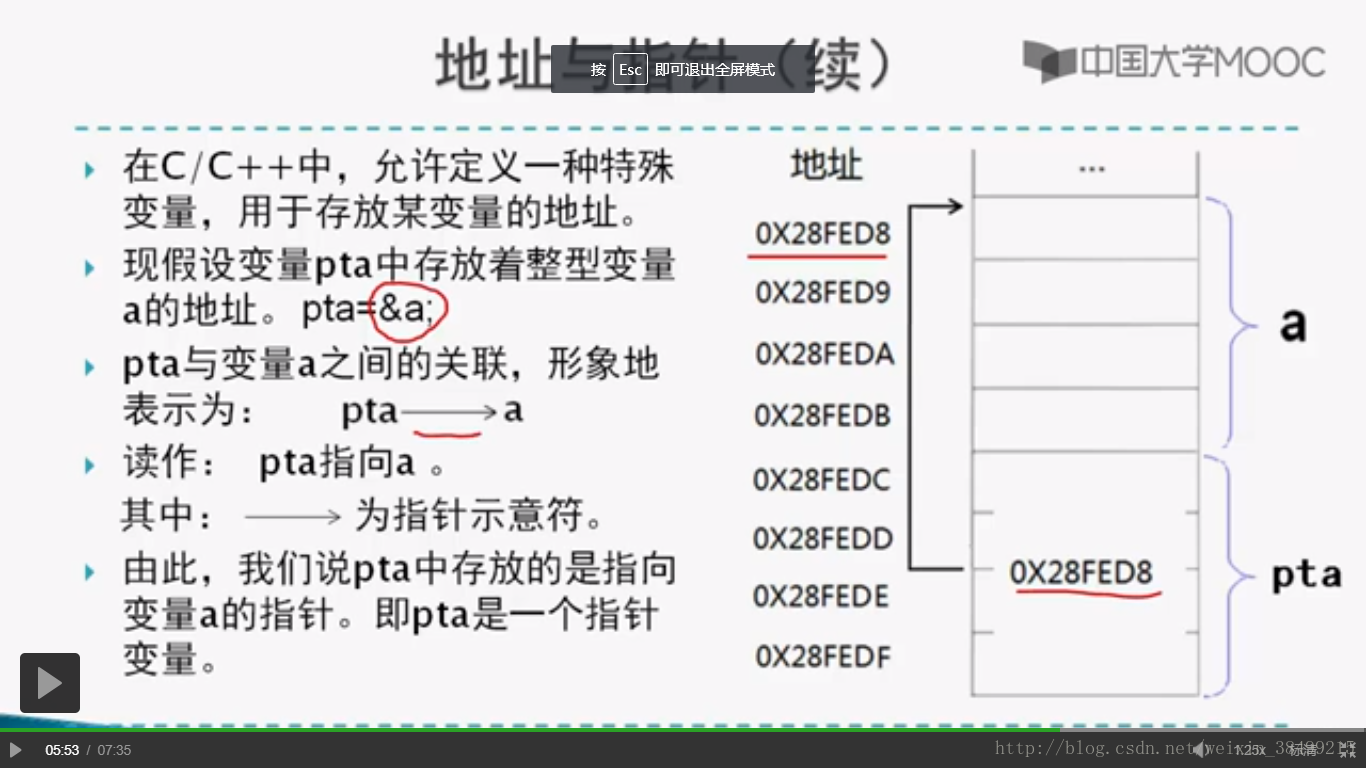
int a = 5, *pta = &a;
等价于
int a, *pta;
a = 5;pta = &a;
void swap(int *xp, int *yp)//形参为指针变量
{
	int t;
	t = *xp;
	*xp = *yp;
	*yp = t;  //注意要交换地址

}

swap(&x, &y);  //实参注意为指针
cout << &a << endl; //a的地址,是指针常量 cout << a << endl; //a的值 cout << &p << endl; //p的地址,指针变量的地址 cout << p << endl; //p的值,a的地址 cout << *p << endl; //p所指变量的值,就是等于a的值 //*p 与*(&a)等价,就是a。 // p是一个指针变量,而&a是一个指针常数。
也可以利用指针参数带回函数的多个值
//利用指针返回多个值

double faver(int s[], int n, int *max, int *min); //桩函数

int main()
{
	int list[5] = { 80,89,67,76,98 }, max, min;
	double aver;
	aver= faver(list, 5, &max, &min);
	cout << "max is " << max << "
min is " << min<<endl;
	cout << "average is " << aver << endl;

}

double faver(int s[], int n, int *max, int *min)
{
	double aver = s[0];
	*max = *min = s[0];

	for (int i = 1; i < n; i++)
	{
		aver += s[i];
		if (s[i] > *max)
		{
			*max = s[i];
		}
		if (s[i] < *min)
		{
			*min = s[i];
		}
	}
	return aver/n;
}
函数返回指针的时候,指针指向主调函数的变量
const char *noBlank(const char* string)
{
	while (*string == " ")
	{
		string++;
	}
	return string;
}

int main()
{
	const char *s1 = "  using namespace std;" , *s2;
	s2 = noBlank(s1);
	cout << s2 << endl;
	return 0;

}
若在函数中直接定义使用,返回多个值,只传递地址,提高运行效率。
- 上一篇:没有了
- 下一篇:没有了